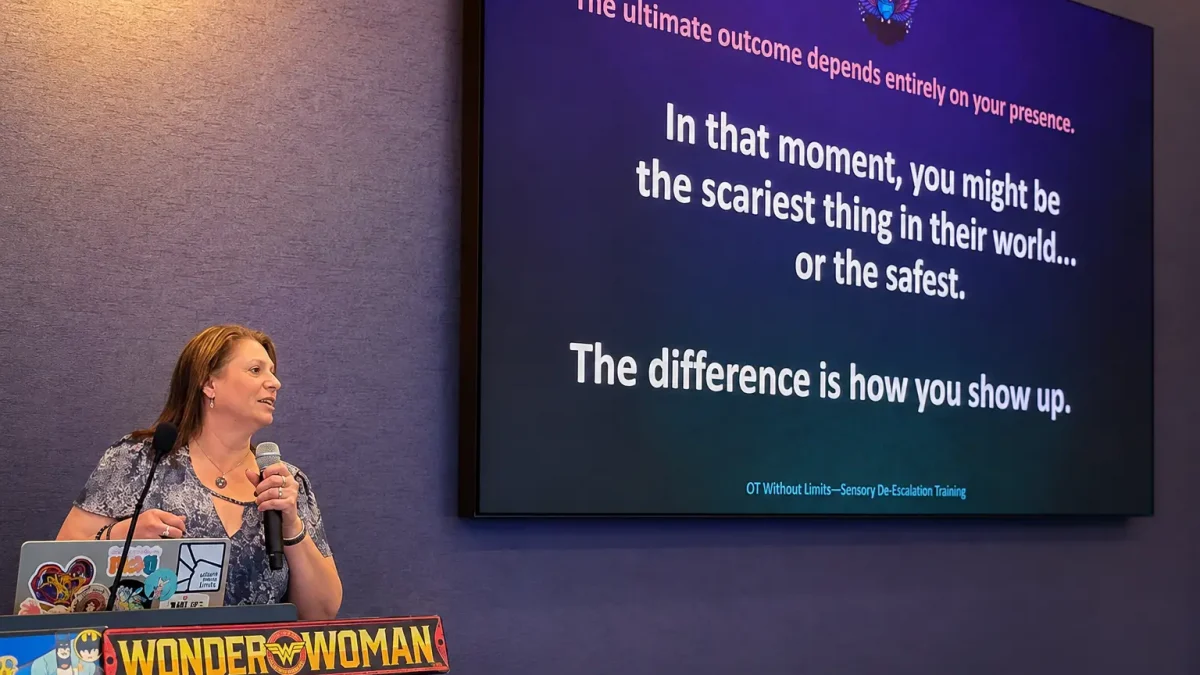
Dr. Carrie recently gave a talk to first responders at Norfolk Southern, in Atlanta, Georgia. An event for first responders in collaboration with the House of Artists Foundation. The topic was about how to approach an autistic person in crisis, and the core message from Dr. Carrie was simple: behavior is communication. During a crisis, an autistic person may not respond to their name, make eye contact, or follow verbal commands, and none of that is defiance. It may reflect sensory overload, processing delays, fear, pain, or difficulty understanding what is happening in the moment.
When first responders understand this, the entire interaction changes. Instead of assuming noncompliance, they can shift into a trauma-informed, neurodiversity-affirming approach that reduces escalation and improves safety. That starts with slowing the scene down enough to let the child’s nervous system catch up.
Why crisis moments look different
Autistic people often process language, sensory input, and environmental change differently, especially under stress. In an emergency, flashing lights, sirens, crowding, touch, and multiple voices can quickly overwhelm the nervous system. What looks like refusal may actually be a shutdown, freeze response, or inability to process competing demands.
This is why standard crisis tactics can backfire if they rely on repeated commands, urgency, or physical proximity. A child who does not answer immediately may still be listening, but needs more time to process language and orient to the situation. Eye contact should never be treated as the test of whether the child is “engaged” or “respectful”.
Three shifts that change outcomes
A safer response often comes down to three small but powerful shifts. First, lower the sensory load by reducing sirens, flashing lights, unnecessary noise, and extra people in the area when safe to do so. Second, use one voice and few words, with a single calm speaker giving short, concrete directions rather than multiple responders talking at once. Third, give time and space, because silence is not refusal and processing delays are real.
These changes can prevent a frightened child from becoming more dysregulated simply because the environment is too much to manage. They also make it easier for caregivers to help, since familiar adults often know what calms the child, what triggers distress, and what communication methods work best. In many situations, connection before direction is the difference between escalation and cooperation.
Practical response principles
First responders can improve outcomes by approaching with calm body language, literal language, and respect for personal space. If possible, they should identify one lead communicator, avoid rapid-fire questions, and allow extra wait time after giving a direction. Using visuals, gestures, or a caregiver’s support can also make communication more accessible.It is also important not to demand eye contact or interpret stimming, avoidance, or silence as resistance. Those behaviors may be self-regulation, fear reduction, or an attempt to cope with an overwhelming scene. The goal is not instant compliance; it is safe, dignified support.
Why this matters
For autistic children and adults, a crisis can become more dangerous when they are misunderstood. When responders assume defiance, they may respond with more pressure, more noise, or more physical control, which can intensify distress. When responders assume difference, they can create enough calm for the person to communicate, recover, or accept help.
That is why education matters so much. Training first responders to recognize autistic communication, reduce sensory stress, and slow down their approach can change the outcome of a call and build trust with families over time. The more a community understands these principles, the safer emergency interactions become for everyone.
Closing message
Autistic people in crisis need responders who see beyond the behavior and respond to the human being underneath it. Lower the sensory load, use one calm voice, give time and space, and lead with connection. Even in uniform, even in a hurry, that approach can protect dignity and save lives. During her presentation at Norfolk Southern to a group of first responders, Dr. Carrie said, “In that moment, you might be the scariest person in their world… or the safest. How you show up is up to you.
Contact us to have Dr Carrie speak to your organization.