What Is Functional Vision?
Functional vision is the way your child uses their eyes and brain together in real life, not just whether they can see the letters on an eye chart. A child can have “20/20” eyesight and still struggle with visual skills such as eye teaming, tracking across a page, shifting focus from near to far, judging space, copying from the board, or using vision to guide body movement (COVD, COVD).
In everyday life, functional vision helps a child read, write, play sports, climb playground equipment, copy from the board, keep their place on a page, and move through busy spaces without feeling overwhelmed. COVD notes that visual skills support reading, learning, sports, and daily life, and that some skills, such as tracking along a line of text, develop over time and can improve with appropriate intervention (COVD, COVD).
This article is educational and is not a diagnosis. If you suspect a vision concern, your child should be evaluated by an appropriate eye-care provider.
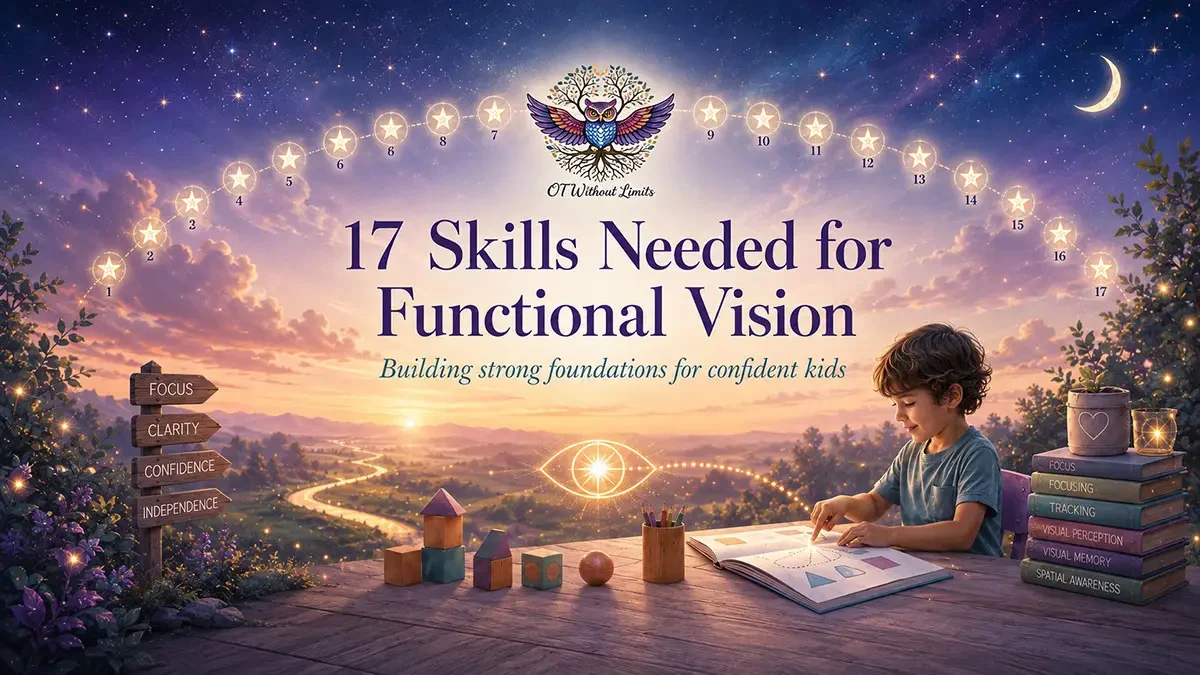
The 17 Skills Needed for Functional Vision
Functional vision includes many different skills working together at the same time. The following 17 skills are commonly described in developmental optometry and vision therapy resources as key visual abilities for school, play, sports, and daily participation (Optometrists.org, COVD).
- Eye movement control: The ability to move both eyes together toward a target or along a path, such as a line of text (Optometrists.org).
- Binocular coordination: The ability of both eyes to work together as a team at the same time (Optometrists.org).
- Saccades: Quick eye jumps between targets, such as moving from one word to the next while reading (Optometrists.org).
- Pursuits: Smooth eye movements used to track a moving object or follow information across space (Optometrists.org).
- Convergence: The ability of both eyes to turn inward together to focus on near work, such as a book, worksheet, or computer screen (Optometrists.org).
- Accommodation flexibility: The ability to change focus between near and far, such as looking from the board to a notebook (Optometrists.org).
- Accommodation endurance: The ability to maintain clear focus during close-up tasks, such as reading, writing, or computer work (Optometrists.org).
- Visual memory: The ability to remember visual information that was just seen or seen previously, such as letters, words, shapes, or spelling patterns (Optometrists.org).
- Visual thinking: The ability to analyze and make meaning from what is seen, sometimes described as visual-spatial or picture thinking (Optometrists.org).
- Central visual acuity: The ability to see clearly and accurately in central vision, which is the skill often measured by a “20/20” eye chart (Optometrists.org).
- Peripheral vision: The ability to notice information to the sides while looking forward (COVD).
- Depth perception: The ability to tell whether objects are closer or farther away from each other (COVD).
- Color perception: The ability to tell different colors apart, when color vision is intact (COVD).
- Gross visual-motor skills: The ability to use visual information to guide whole-body movement, such as walking through a crowded room, climbing, catching, or playing sports (Optometrists.org).
- Fine visual-motor skills: The ability to use vision to guide small, precise movements, such as handwriting, cutting, drawing, texting, or threading beads (Optometrists.org).
- Visual perception: The ability to understand and interpret what is seen in the visual field (Optometrists.org).
- Visual integration: The ability to combine vision with other senses and motor skills to complete complex tasks, such as copying, tying shoes, catching a ball, or reading while moving (Optometrists.org, COVD).
Signs Your Child May Have a Functional Vision Issue
A functional vision challenge can show up as a school problem, a behavior problem, a coordination problem, or a fatigue problem. Parents may notice that their child avoids reading, loses their place, skips words, reverses letters beyond the expected developmental window, rubs their eyes, complains of headaches, becomes tired with near work, struggles to copy from the board, bumps into objects, dislikes ball play, or has difficulty with handwriting and spacing.
These signs do not automatically mean a child has a vision disorder. They are clues that the child may need a more complete look at how their eyes, brain, body, and attention systems are working together.
Who Should You See If You Suspect a Functional Vision Issue?
If you suspect your child has a functional vision issue, a good first step is a comprehensive eye examination with an eye-care provider who evaluates more than visual acuity. A standard screening may identify whether a child can see clearly at a distance, but functional concerns often require evaluation of skills such as eye teaming, focusing, tracking, depth perception, and visual-motor integration (COVD, Optometrists.org).
For suspected binocular vision, convergence, tracking, or focusing problems, parents often seek an optometrist with advanced training in developmental vision or optometric vision therapy. COVD describes optometric vision therapy as in-office therapy conducted under the supervision of an optometrist, and it specifically notes that skills such as tracking together along a line of text can be learned during development and improved later in life (COVD).
If your child has eye pain, sudden vision changes, eye injury, eye disease, a medical diagnosis affecting vision, or a possible surgical concern, an ophthalmologist is the appropriate medical eye specialist. AAPOS explains that ophthalmologists are medical doctors who can treat eye problems and perform eye surgery (AAPOS).
What Is an Optometrist?
An optometrist is a vision-care provider who evaluates how well a person sees, prescribes glasses or contact lenses, identifies some eye problems, and may prescribe certain eye medications depending on training and state law. AAPOS explains that optometrists are not medical doctors, but they study eyes for many years and can provide glasses or contacts, identify some eye problems, and provide some eye medications (AAPOS).
For children with functional vision concerns, an optometrist may evaluate visual acuity, refractive needs, eye teaming, focusing, and eye movement skills. If the optometrist has advanced training in developmental vision or vision therapy, they may also assess how visual skills affect reading, learning, sports, and daily participation.
What Is an Ophthalmologist?
An ophthalmologist is a medical doctor, either an M.D. or D.O., who specializes in the medical and surgical care of the eyes. AAPOS explains that ophthalmologists can treat eye problems, perform eye surgery, and may specialize in particular eye conditions or treatments (AAPOS).
A pediatric ophthalmologist is especially important when a child has a known eye disease, eye injury, strabismus, amblyopia, neurological concerns, medical red flags, or a condition that may require medical or surgical management. AAPOS describes pediatric ophthalmologists and strabismologists as physicians who specialize in children’s eye problems and eye misalignment (AAPOS).
What Is a Developmental Optometrist?
A developmental optometrist is an optometrist who focuses on how vision develops and how visual skills affect learning, movement, attention, and daily function. This may include evaluation and treatment of binocular vision, eye tracking, focusing, convergence, visual processing, and visual-motor concerns.
Developmental optometry is often associated with optometric vision therapy and rehabilitation. COVD describes its mission as advancing excellence in optometric vision therapy and rehabilitation through education and board certification, and it provides resources for locating doctors who work in this area (COVD, COVD Doctor Locator).
How Can Occupational Therapists Help?
Occupational therapists look at how a child participates in daily activities, including play, school tasks, self-care, movement, handwriting, feeding, dressing, and social participation. Because vision is tightly connected to posture, balance, body awareness, motor planning, sensory processing, attention, and hand use, functional vision concerns can affect many areas that OTs evaluate and treat.
An occupational therapist does not replace an optometrist or ophthalmologist. Instead, an OT can help identify functional signs that may warrant referral, support visual-motor skills, adapt tasks and environments, collaborate with the eye-care team, and help the child use improved visual skills during meaningful daily activities.
For example, a child with binocular vision difficulty may also struggle with handwriting endurance, copying, catching a ball, reading posture, desk setup, balance, or fatigue. A specialized OT can support the child’s participation by addressing body positioning, ocular-motor activities within the OT scope of practice, visual-motor integration, fine motor control, bilateral coordination, sensory regulation, and environmental modifications.
If a child is receiving optometric vision therapy, OT can help bridge those visual gains into real-world function. That may include practicing visual scanning during play, using both eyes and hands together during crafts, improving near-work posture, building tolerance for school tasks, supporting ball skills, or helping the child feel more confident in movement-based activities.
When OT and Eye Care Work Best Together
The best care often happens when professionals communicate instead of working in silos. The eye-care provider evaluates and diagnoses the visual system, prescribes lenses or prisms when appropriate, and guides medical or optometric treatment; the OT supports how those visual skills show up in daily life, school participation, motor development, sensory regulation, and independence.
If you are a parent, you do not have to figure this out alone. If your child is bright but avoids reading, melts down during homework, struggles with handwriting, bumps into things, complains of headaches, loses their place, or seems exhausted by visual tasks, it may be time to ask whether functional vision is part of the picture.
Parent Takeaway
Functional vision is more than “Can my child see clearly?” It is “Can my child use vision comfortably and efficiently to learn, move, play, read, write, and participate?”
If you suspect a functional vision issue, consider starting with a comprehensive eye examination and ask whether the provider evaluates binocular vision, tracking, focusing, convergence, and visual-motor concerns. If daily routines, school performance, handwriting, sensory regulation, or movement skills are also affected, an occupational therapist with advanced training in vision-related concerns can be a valuable part of your child’s team.