At the heart of OT Without Limits is a simple belief:
Every child has extraordinary potential—and no child should be defined by the things that feel difficult today.
A child may struggle with getting dressed, sitting through a lesson, trying unfamiliar foods, managing big feelings, coordinating their body, or keeping up with everyday routines. These challenges can sometimes look like defiance, distraction, avoidance, or lack of effort.
But behavior is only the part we can see.
Underneath it may be a nervous system working hard to process sensory information, immature reflex patterns affecting movement and attention, visual skills that make learning exhausting, or emotions that feel too big for a child to manage alone.
OT Without Limits was created to look beneath the surface.
Rather than asking, “How do we stop this behavior?” we begin with a different question:
“What is this child’s body, brain, and heart trying to tell us?”
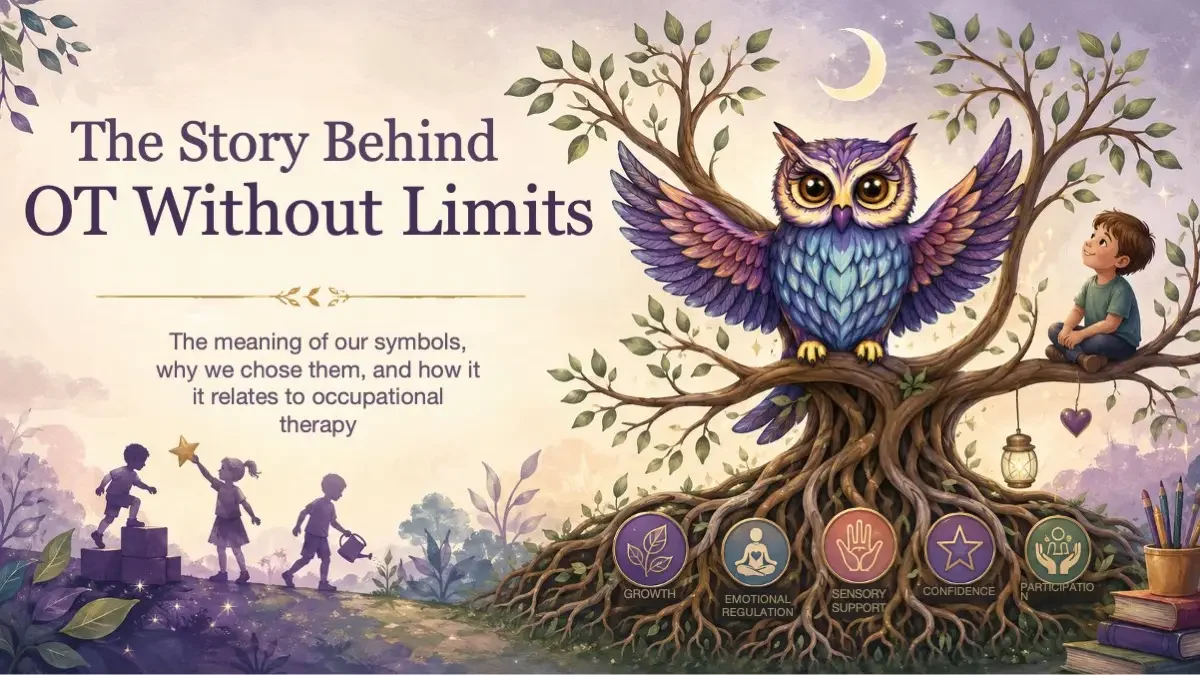
That question represents the foundation of our work—and the meaning behind every part of the OT Without Limits symbol.
The Owl: Wisdom, Awareness, and Seeing Beyond the Surface
The owl is the heart of the OT Without Limits logo.
Owls are often associated with wisdom, observation, and the ability to see what others may overlook. That reflects the way we approach occupational therapy.
We do not see a child who is “being difficult.”
We see a child communicating a need.
We look closely at the many systems that influence participation, including sensory processing, movement, reflex development, vision, coordination, attention, emotional regulation, and confidence.
The owl’s large, watchful eyes represent our commitment to seeing the whole child. We pay attention not only to what a child is doing, but also to what may be happening underneath the behavior.
The owl also reminds us to remain curious. Every child is different, and meaningful progress begins when we listen, observe, and seek to understand.
The Wings: Freedom, Confidence, and Possibility
The owl’s wings are fully extended, reaching beyond the center of the logo.
They represent freedom—the freedom to move, play, learn, communicate, explore, and participate in daily life with greater confidence.
For some children, everyday experiences can feel limiting. A noisy classroom may feel overwhelming. Handwriting may require tremendous effort. A simple change in routine may bring anxiety. Getting dressed, playing with friends, or calming down after disappointment may feel harder than others realize.
Occupational therapy helps reduce those barriers.
Our goal is not to change who a child is. It is to help each child develop the skills, strategies, and foundations they need to engage with the world in a way that feels successful and authentic.
The wings remind us that progress is not about fitting every child into the same mold. It is about helping children discover what allows them to soar.
The Tree: Growth, Connection, and the Whole Child
Behind the owl stands a strong, living tree.
A tree grows gradually. Its branches stretch outward while its roots reach deeply into the ground. Every part is connected, and healthy growth depends on the strength of the entire system.
Children develop in much the same way.
Movement can affect attention. Sensory processing can influence emotional regulation. Vision can affect reading, coordination, and confidence. Reflex development can influence posture, balance, body awareness, and the ability to sit still.
Development does not happen in isolated pieces.
The tree represents our whole-child approach. Instead of focusing only on one visible skill, we consider how a child’s body, brain, emotions, environment, and everyday experiences work together.
The branches symbolize expanding skills and possibilities. Each new leaf represents growth—sometimes dramatic, but often found in small, meaningful victories:
Trying a new food.
Tolerating a difficult sound.
Joining a playground game.
Writing without becoming exhausted.
Recognizing a feeling before it becomes overwhelming.
Completing a morning routine with greater independence.
These moments may seem small from the outside, but to a child and family, they can change everything.
The Roots: Building Strong Foundations
The roots are one of the most important elements of the logo.
Although roots are often hidden, they provide stability, nourishment, and support for everything growing above them. In the same way, many of the foundations children need for everyday success cannot be seen easily.
Before expecting a child to sit still, we may need to understand how their body processes movement.
Before expecting neat handwriting, we may need to support posture, hand strength, visual-motor skills, and reflex development.
Before expecting a child to “calm down,” we may need to help them recognize body signals, name their feelings, feel safe, and discover regulation strategies that actually work for their nervous system.
At OT Without Limits, we believe lasting progress begins at the roots.
We look beyond the immediate task to explore the sensory, reflex, visual, motor, emotional, and environmental foundations supporting it. When those roots become stronger, skills can grow more naturally and confidently.
The Moon: Calm, Rhythm, and Hope
Above the tree rests a crescent moon.
The moon represents calm, reflection, rhythm, and change. It reminds us that development happens in seasons and cycles. Progress is rarely a straight line. Children may move forward, pause, struggle, and grow again.
The moon also reflects the quiet moments that matter: a child taking a breath, asking for help, identifying a feeling, or finding their way back to calm after a difficult experience.
Emotional regulation is not about preventing children from ever feeling angry, worried, disappointed, excited, or overwhelmed. Feelings are a natural part of being human.
Regulation means helping children understand what they are feeling, notice what is happening in their bodies, express their needs safely, and use supportive tools to move through those emotions.
The moon offers a symbol of hope: even during difficult seasons, growth is still happening.
The Colors: Individuality, Creativity, and Neurodiversity
The owl is filled with vibrant colors rather than a single shade.
Those colors celebrate the uniqueness of every child.
There is no single “right” way to think, learn, communicate, move, or experience the world. Each child brings their own strengths, interests, personality, ideas, and perspective.
Our role is not to erase those differences.
Our role is to honor the child in front of us while helping them participate more fully in the activities and relationships that matter to them.
The colors represent creativity, individuality, and the belief that different does not mean less capable. Every child’s path may look different, and every path deserves respect.
What Is Occupational Therapy?
The word occupation can be confusing because many people associate it with a job.
In occupational therapy, an occupation is any meaningful activity that fills a person’s day.
For a child, occupations include:
Playing
Learning
Getting dressed
Eating
Sleeping
Making friends
Participating in family routines
Managing feelings
Moving safely and confidently
Completing school activities
Exploring the world
Pediatric occupational therapy helps children participate more successfully in these everyday experiences.
An occupational therapist may support fine-motor skills, sensory processing, coordination, visual-motor development, attention, self-care, play, emotional regulation, social participation, or independence with routines.
But occupational therapy is not simply a collection of exercises.
It is about helping a child do the things they need and want to do.
Sometimes that means developing a new skill. Sometimes it means changing the environment, introducing a supportive tool, teaching the adults around the child, or finding a different way to complete an activity.
The goal is meaningful participation—not perfection.
Why “Without Limits”?
The name OT Without Limits represents our commitment to looking beyond labels, behaviors, assumptions, and traditional boundaries.
We believe therapy should extend beyond the clinic and connect to real life. Strategies should make sense at home, at school, on the playground, and within the daily routines that matter most to a family.
“Without Limits” does not mean promising that every challenge will disappear.
It means refusing to place unnecessary limits on a child’s potential.
It means recognizing strengths alongside struggles.
It means remaining curious when something is not working.
It means adapting the plan rather than blaming the child.
It means helping children understand their bodies, communicate their feelings, develop confidence, and build greater independence.
Most importantly, it means allowing children to grow into who they are—not who the world expects them to be.
Growing From the Roots and Learning to Fly
Every part of the OT Without Limits logo tells the same story.
The roots remind us to build strong foundations.
The tree reminds us that every part of development is connected.
The moon reminds us to honor each child’s rhythm.
The colors celebrate individuality.
The owl reminds us to look closely and seek understanding.
And the wings remind us why we do this work.
We want children to feel capable.
We want families to feel understood.
We want everyday life to feel more manageable.
We want each child to have the support, confidence, and freedom to spread their wings.
Because when we look beyond the surface, strengthen the foundations, and honor the whole child, possibility becomes greater than limitation.
That is the heart of OT Without Limits.