Tantrum vs. Sensory Meltdown: How to Tell the Difference and Support Your Child
When a child is crying, yelling, dropping to the floor, or refusing to move, it can be hard to know what is really happening. From the outside, a tantrum and a sensory meltdown can look very similar. Inside the child’s body, though, the “why” may be very different.
For parents, teachers, and caregivers, understanding the difference matters because the support that helps one situation may not help the other. A tantrum often needs calm limits and simple choices, while a sensory meltdown usually needs reduced demands, safety, and nervous-system support.
What is a tantrum?
A tantrum is a big emotional response that often happens when a child is frustrated, tired, hungry, or unable to get something they want or need. Tantrums are a normal part of development and happen most often between ages 1 and 3.
During a tantrum, a child may still be somewhat aware of what is happening around them. They may check to see how adults are responding, pause when attention changes, or calm more quickly once the limit is clear or the need is met.
This does not mean the child is “bad” or “manipulative.” It means the child is still learning how to handle disappointment, wait, use words, and tolerate limits.
Common tantrum triggers can include:
- Being told “no”
- Wanting a toy, snack, screen, or activity
- Trouble communicating a need
- Feeling hungry, tired, rushed, or overwhelmed
- Difficulty moving from one activity to another
Use strategies such as offering small choices, using distraction, knowing a child’s limits, preparing for hunger or fatigue, and staying calm during tantrums.
What is a sensory meltdown?
A sensory meltdown is not about “getting their way.” It is a nervous-system response to too much sensory input, too little helpful input, or input the child’s body experiences as threatening or overwhelming.
Sensory processing challenges can make everyday sounds, lights, clothing, movement, touch, or busy environments feel overwhelming for some children. A child may do well in a calm space but fall apart in a grocery store, birthday party, school cafeteria, or noisy classroom because the sensory load is too high.
During a sensory meltdown, the child may not be able to use language, reason through choices, or respond to typical behavior strategies. Their body may be in fight, flight, freeze, or shutdown mode.
Signs a meltdown may be sensory-based include:
- Covering ears, hiding eyes, or trying to escape
- Becoming distressed in noisy, bright, crowded, or unpredictable places
- Refusing clothing, shoes, grooming, toothbrushing, or face washing
- Crashing, running, pushing, or seeking deep pressure
- Becoming more upset when adults talk more, ask questions, or add demands
- Needing significant time, quiet, movement, pressure, or co-regulation to recover
Children with sensory issues may be hypersensitive, meaning overwhelmed by sensory input, or hyposensitive, meaning they seek more input from their environment.
Why the same behavior can mean different things
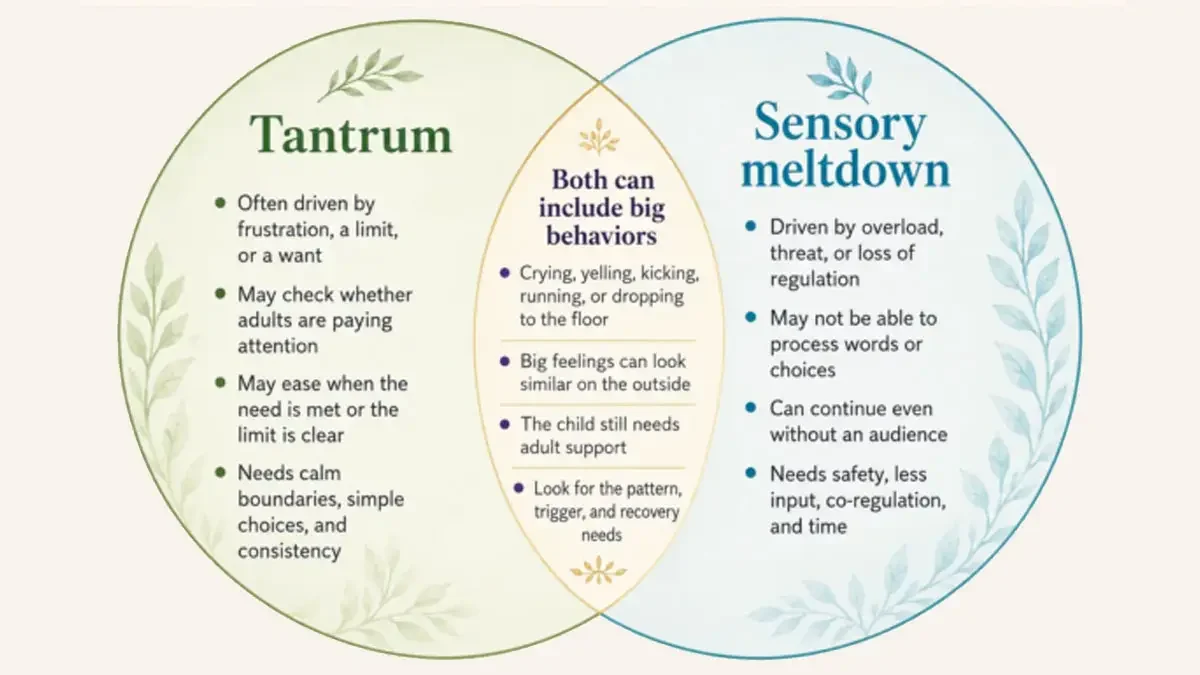
Kicking, screaming, crying, biting, running away, and dropping to the floor can happen during both tantrums and sensory meltdowns. The behavior alone does not tell the whole story.
The more helpful question is: “What is driving this behavior?”
If the child is trying to gain or avoid something, a tantrum may be more likely. If the child is overloaded, unsafe in their body, or unable to process the environment, a sensory meltdown may be more likely.
Here is a quick way to compare:
What you notice | Tantrum | Sensory meltdown |
Main driver | Frustration, limit, want, or goal | Overload, sensory threat, or loss of regulation |
Awareness | May check adult response | May seem unable to process words or choices |
What helps | Calm limit, simple choice, consistency | Reduce input, support safety, co-regulate |
Recovery | Often improves when the issue is resolved | May need time, quiet, movement, pressure, or rest |
Teaching moment | After calm, teach words and expectations | After calm, identify triggers and regulation tools |
How to respond to a tantrum
Start by staying calm and keeping the child safe. If a child is hitting, biting, throwing, or running toward danger, do not ignore those behaviors and stop them immediately for safety.
For many tantrums, less talking is better. Use a short phrase such as, “I know you want the tablet. Tablet is all done. You can choose blocks or books.”
Helpful tantrum supports include:
- Offer two acceptable choices.
- Use a calm, steady voice.
- Keep the limit simple and consistent.
- Praise the child when they regain control.
- Avoid giving the original demand just to stop the behavior.
- Look for patterns such as hunger, fatigue, transitions, or too many “no” moments.
After the child is calm, keep the repair short. You might say, “That was hard. You were mad the tablet was finished. Next time you can say, ‘I’m mad’ or ask for help.”
How to respond to a sensory meltdown
During a sensory meltdown, the first goal is not teaching. The first goal is safety and regulation.
Reduce the sensory load when possible. This may mean lowering your voice, dimming lights, moving away from a crowd, removing scratchy clothing, offering noise reduction, or creating space.
Supportive sensory-based strategies may include:
- Move to a quieter or less crowded area.
- Use fewer words and avoid rapid questions.
- Offer deep pressure if the child likes it and it is safe.
- Provide a predictable phrase such as, “You are safe. I’m here.”
- Allow recovery time before discussing what happened.
- Notice triggers so you can plan ahead next time.
Occupational therapy practitioners can evaluate a child’s sensory needs and provide individualized, play-based sensory integration supports after an evaluation, according to the American Occupational Therapy Association (AOTA). This is important because sensory strategies are not one-size-fits-all.
A helpful OT reframe
Instead of asking, “How do I stop this behavior?” try asking, “What skill or support is my child missing right now?”
For a tantrum, the missing skill may be waiting, flexibility, communication, or tolerating frustration. For a sensory meltdown, the missing support may be environmental modification, body-based regulation, predictability, or a better sensory plan.
Both situations deserve compassion and boundaries. A child can need support and still need safety limits.
When to ask for help
Talk with your pediatrician or an occupational therapist if outbursts are frequent, intense, unsafe, hard to recover from, or interfering with school, family routines, sleep, dressing, feeding, hygiene, or community outings. It is also recommended to talk with a pediatrician when caregivers are concerned about tantrum behaviors.
An occupational therapy evaluation can help identify whether sensory processing, motor planning, self-regulation, communication, routines, or environmental demands may be contributing. From there, families can build a plan that supports the child before, during, and after big feelings.
Final thought
Tantrums and sensory meltdowns can look alike, but they are not always the same. When we understand the difference, we can respond with more confidence, more compassion, and more effective support.
If your child’s big reactions are leaving you unsure what to do next, OT without limits can help you look beneath the behavior and build practical strategies that fit your child’s nervous system, routines, and family life.