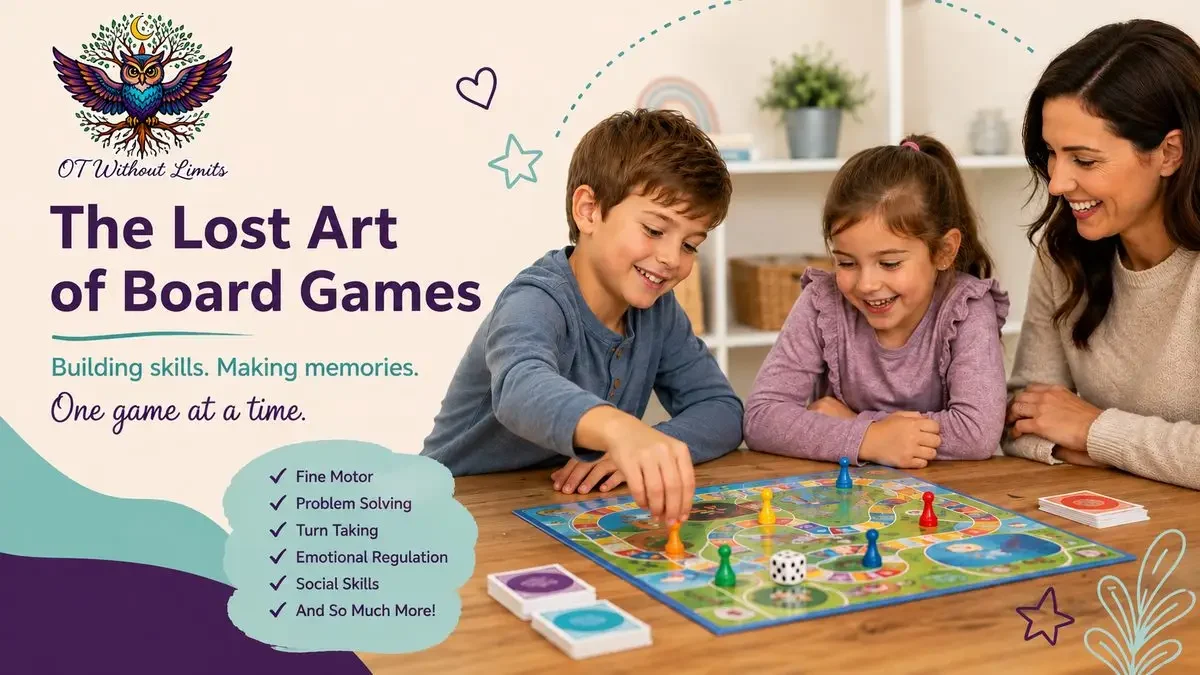
The Lost Art of Board Games: Why Playing Together Builds So Much More Than Fun
In a world full of tablets, streaming, video games, and instant entertainment, the humble board game can feel a little old-fashioned.
But from an occupational therapy perspective, board games are incredible.
A single game played around the kitchen table can challenge fine motor skills, visual processing, attention, problem-solving, emotional regulation, communication, social skills, executive functioning, and independence — often all at the same time.
And the best part is that children usually just think they are playing.
That is the beauty of play.
Board Games Are Full of Hidden Skills
Occupational therapists often look at activities differently than other people might.
Instead of simply seeing a child roll dice, move a game piece, or wait for their turn, we see the underlying skills that make those actions possible.
A board game can become a miniature workout for the brain and body.
Fine Motor and Bilateral Coordination Skills
Think about everything a child’s hands might need to do during a game:
- Pick up and manipulate small game pieces
- Hold and roll dice
- Spin a spinner
- Stack or balance objects
- Place tiny pieces into specific spaces
- Shuffle, sort, hold, or deal cards
- Stabilize the board with one hand while moving a piece with the other
- Hold a group of cards in one hand while selecting and playing a card with the other
These actions require finger strength, coordination, dexterity, grasp development, and controlled hand movements.
Board games also provide wonderful opportunities for bilateral coordination — the ability to use both sides of the body together in a coordinated way, such as holding a spinner stable while flicking the spinner with the other hand.
Sometimes both hands perform similar actions, such as shaking dice between two hands. Other times, each hand has a different job. One hand might stabilize a stack of cards while the other draws a card, or one hand may hold game pieces while the other places them on the board.
These same bilateral skills are important for everyday activities such as cutting with scissors, tying shoes, buttoning clothing, opening containers, using utensils, handwriting, and participating in sports.
Even something as simple as picking up a small token and placing it accurately on the board requires multiple systems to work together — the eyes have to locate the piece and its destination, the hand has to reach and grasp it, and the fingers have to grade their force well enough to move it without knocking everything else over.
That is a lot happening during one little turn!
Learning Through Play: Counting, Colors, Matching, and More
Board games can also reinforce early academic and cognitive concepts without making learning feel like a lesson.
Depending on the game, children may naturally practice:
- Counting objects and spaces
- One-to-one correspondence
- Number recognition
- Color recognition
- Shape recognition
- Matching
- Sorting and categorizing
- Comparing quantities
- Recognizing patterns
- Sequencing
- Following directions
- Problem-solving and strategy
- Understanding concepts such as more, less, same, first, next, and last
Consider something as simple as rolling a die and moving a game piece.
First, the child must recognize or count the dots on the die. Then they need to move their piece that number of spaces, moving one space for each number counted.
That seemingly simple action combines number concepts, counting, one-to-one correspondence, visual attention, motor planning, and impulse control.
Matching games offer another great example. A child may be learning to recognize identical pictures, colors, shapes, letters, or numbers while also remembering where cards are located, waiting for a turn, visually scanning the playing area, and managing the disappointment of turning over the wrong card.
For younger children, games can provide repeated exposure to colors, numbers, shapes, and vocabulary. As children grow, games can begin incorporating addition, subtraction, spelling, reading, money concepts, strategy, and increasingly complex problem-solving.
And because these concepts are embedded in play, children have a meaningful reason to use them.
They aren’t counting because someone handed them a worksheet and told them to count.
They’re counting because they really want to know if they finally made it to the finish line.
That motivation matters.
It is another example of why play is such a powerful way to learn.
Visual-Motor and Visual-Perceptual Skills
Board games also require children to constantly use visual information.
They may need to:
- Find their game piece among several others
- Scan the board for a certain color or picture
- Follow a pathway
- Match cards
- Count spaces
- Recognize patterns
- Locate objects within a busy visual field
- Judge where pieces belong
These are the same kinds of visual-motor and visual-perceptual skills children rely on during handwriting, reading, classroom work, dressing, sports, and everyday routines.
Attention to Task
Board games ask children to stay engaged with an activity that unfolds over time.
Unlike many forms of digital entertainment, the game does not necessarily provide constant movement, flashing lights, sound effects, or immediate rewards.
Children must remain present.
They need to follow what is happening, remember whose turn it is, watch other players, and return their attention to the game when it is time to act.
For some children, completing even a short game can be meaningful practice in sustained attention.
Over time, families can gradually introduce games that require longer periods of focus.
Problem-Solving and Flexible Thinking
Many games require children to make decisions.
Should I move this piece or that one?
Which card should I play?
What happens if I make this choice?
Can I try a different strategy?
Children learn to predict outcomes, recognize patterns, plan, adapt when something unexpected happens, and solve problems as they arise.
They also learn something incredibly important:
Sometimes your first idea does not work.
That means you must adjust.
This kind of flexible thinking is important far beyond the game table. Children need it when schoolwork becomes difficult, plans change, friendships become complicated, or everyday routines do not go as expected.
I’d make positioning its own short section because it highlights another layer of OT that parents may not realize can be built into something as simple as playing a game.
Positioning: Changing the Body Changes the Challenge
Who says board games have to be played sitting at a table?
Changing the position a child plays in can turn the same game into an opportunity to work on postural control, core strength, shoulder stability, upper-body strength, balance, and endurance.
A child might play:
- Seated upright at a table
- Criss-cross on the floor
- Lying on their belly and propped on their elbows (prone)
- On hands and knees (quadruped)
- In different positions throughout the game
Each position places different demands on the body.
Sitting upright at a table requires a child to maintain their posture while keeping their hands free to manipulate cards, dice, and game pieces. Sitting criss-cross on the floor changes the child’s base of support and asks the trunk to work differently to maintain an upright position.
Playing on the belly (prone) while propped on the elbows encourages weight-bearing through the arms while working the shoulders, upper back, neck, and postural muscles. In quadruped, or on hands and knees, the challenge increases as the child supports their body while shifting their weight to reach for a card, roll the dice, or move a game piece.
An occupational therapist can intentionally choose or change a child’s position based on the skills they are working to develop. A child might play several turns in one position and then switch to another, allowing movement to become a natural part of the activity while gradually building strength and endurance.
And once again, the child may simply think:
We’re playing a game.
But underneath that play, their body is working hard to provide the stable foundation needed for so many everyday activities.
Because sometimes changing how we play changes everything the activity can offer.
Turn Taking and Impulse Control
Waiting can be hard.
Board games naturally create opportunities to practice it.
A child may know exactly what move they want to make, but they still have to wait while another person takes a turn.
They may have to resist touching pieces, interrupting, grabbing cards, or moving ahead before it is time.
This is real-world impulse control in action.
And because it happens within play, children can practice these skills repeatedly in a meaningful context.
Emotional Regulation and Frustration Tolerance
Perhaps one of the most valuable parts of playing games is that sometimes things do not go your way.
You roll the wrong number.
Someone takes the card you wanted.
Your carefully planned move fails.
You were winning — and suddenly you are not.
You lose.
These moments create opportunities to practice emotional regulation in a relatively safe environment.
A child can begin learning how to notice disappointment, frustration, excitement, nervousness, and anger without allowing those feelings to completely take over.
They can practice taking a breath, asking for help, trying again, accepting an unexpected outcome, and continuing even when something feels difficult.
That is frustration tolerance.
And like any other skill, it grows through practice.
Fair Gameplay and Sportsmanship
Winning feels good.
Losing usually does not.
Board games give children repeated opportunities to learn that both experiences are part of playing with other people.
They begin learning how to follow rules even when the rules do not benefit them.
They practice being honest.
They learn that changing the rules halfway through a game because they are losing is probably not going to go over very well.
They learn how to say, “Good game.”
They learn how to celebrate without humiliating someone else.
They learn how to lose without destroying the game board.
These may sound like small lessons, but they are foundational social-emotional skills.
Good sportsmanship requires empathy, self-control, perspective-taking, and respect for others.
Socialization and Connection
Games also give families and children something increasingly valuable:
A reason to sit together.
There is conversation.
There are shared jokes.
There are negotiations.
There are silly moments.
Children watch facial expressions and body language. They learn how other people react. They practice asking questions, explaining ideas, listening, and responding.
For children who struggle socially, structured games can sometimes make interaction easier because everyone has a shared activity and clear expectations.
Instead of being told simply to “go socialize,” the game provides a framework for the interaction.
Communication Skills
Depending on the game, children may need to describe, explain, ask, negotiate, request, answer, or clarify.
They might need to tell another player what happened.
They may have to explain a strategy.
They may need to ask whose turn it is.
They may disagree and work through it.
Communication during play feels different from a worksheet or structured lesson because there is a genuine reason to communicate.
Something is happening.
The child has something they want to say.
Planning, Organization, and Executive Functioning
Before the game even begins, there may already be skills to practice.
Find the game.
Bring it to the table.
Open the box.
Sort the pieces.
Set up the board.
Pass out the cards.
Remember the rules.
Decide who goes first.
Then, during the game, the child may need to keep track of several pieces of information at once.
These are executive functioning skills — the mental processes that help us organize, plan, remember, start, and complete tasks.
And Then There Is Cleaning Up
The game is over.
Now what?
For many children, this may be one of the most important parts.
Cleaning up a board game requires children to shift from a preferred activity to a less preferred task.
They need to sort pieces, locate missing items, organize materials, put cards back into the correct places, close the box, and return it to where it belongs.
That is sequencing.
Organization.
Responsibility.
Task completion.
Transitioning.
And independence.
Play does not have to end when someone wins.
The entire routine — taking the game out, setting it up, playing, and putting it away — is part of the learning opportunity.
One Activity. So Many Skills.
This is one of the reasons occupational therapists love activities like board games.
Human development does not happen one isolated skill at a time.
A child does not use fine motor skills for five minutes, then turn those off and activate social skills.
Real life requires systems to work together.
During one game, a child might be:
holding cards,
scanning the board,
remembering a rule,
waiting for a turn,
planning a move,
managing disappointment,
talking with another player,
and controlling their body —
all within a few seconds.
That is what makes play such a powerful therapeutic tool.
How Occupational Therapy Can Help
For some children, family game night is easy and fun.
For others, it can quickly become overwhelming.
A child may struggle to sit long enough to finish.
They may become extremely upset when they lose.
They may grab pieces from other players.
They may have difficulty understanding the rules.
They may struggle to move small pieces.
They may constantly lose their place on the board.
They may have trouble planning what to do next.
They may avoid games completely because the experience feels too difficult.
An occupational therapist can help identify the underlying reason.
Instead of simply saying a child “doesn’t like games” or “needs to learn how to lose,” we can ask deeper questions.
Is maintaining attention difficult?
Are the visual demands overwhelming?
Is fine motor manipulation frustrating?
Is waiting especially challenging?
Does the child struggle with unexpected outcomes?
Are they having difficulty understanding another player’s perspective?
Is emotional regulation breaking down when the game becomes unpredictable?
Once we understand what is making the activity difficult, we can adapt it.
We might shorten the game.
Use fewer pieces.
Create a visual reminder of the rules.
Play cooperatively before introducing competition.
Practice losing in small doses.
Use larger game pieces.
Add movement breaks.
Pair the game with regulation strategies.
Choose a game that specifically challenges a skill the child is ready to develop.
The goal is not simply to make a child better at board games.
The goal is to use meaningful activities to build skills that carry into everyday life.
Bringing Back Family Game Night
Board games do not need to be complicated.
You do not need a closet full of expensive games.
A deck of cards can do a lot.
So can dominoes.
Matching games.
Simple dice games.
Puzzles.
Classic childhood games.
The best game is not necessarily the one labeled “educational.”
It is the one your child will engage with that provides just enough challenge to help them grow.
Start small.
Choose something developmentally appropriate.
Expect mistakes.
Model how to handle losing.
Celebrate effort, flexibility, kindness, and persistence — not just winning.
And remember that when your child is sitting at the table laughing, thinking, reaching, waiting, negotiating, planning, and trying again, far more is happening than meets the eye.
They are building skills for life.
Sometimes occupational therapy looks like exercises, assessments, and carefully designed treatment plans.
And sometimes?
It looks like rolling the dice and seeing what happens next.
Play more. Connect more. Build skills without limits.